
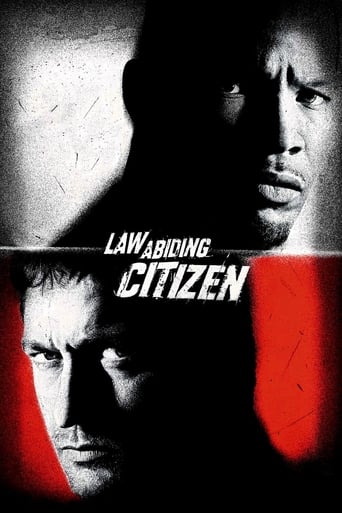
2009 · Drama, Crime

Law Abiding Citizen

Justice at any cost.

Law Abiding Citizen poster
Released
15 Oct 2009
Runtime
109 min
Rating
R
Director
F. Gary Gray
Language
EN
Country
United Kingdom
Budget
$53,000,000
Box office
$127,900,000
Synopsis

A frustrated man decides to take justice into his own hands after a plea bargain sets one of his family's killers free. He targets not only the killer but also the district attorney and others involved in the deal.

Cast
Watch trailer

THE NITPICK BOARD

9 nitpicks Sign in to nitpick
4.2k
Factual error by francesca91 · 24 Nov 2010
The coordinates given by Clyde Shelton—39° 57' 4"N 75° 10' 22"W—point to 1919 Sansom Street, an apartment complex in Center City Philadelphia. However, the scene actually takes place underneath the George C. Platt Memorial Bridge, which is located about 4.3 miles southwest at 39° 53' 49"N 75° 12' 46"W.
3.2k
Plot hole by d.hagan · 25 Aug 2023
After planting the bomb, Clyde gets back to his van, watches the live stream of the meeting, and simply shifts into gear to drive away. He never turns the key, even though he definitely didn't leave the engine running. Leaving a vehicle idling would invite anyone to steal his only getaway ride, and it would immediately look suspicious to the heavy police presence outside, which is the last thing a meticulous planner like Clyde would risk.
2.5k
Logic fail by evan_hickman79 · 14 Mar 2024
When Clyde walks into his cell at the end of the movie, he is completely caught off guard. For a guy who spent the whole film being portrayed as an absolute genius who thinks ten steps ahead, it makes no sense that his secret tunnel didn't have a single tripwire, alarm, or backup plan. He just walks right into a trap and dies a pretty foolish death, which completely goes against how smart and deadly he was supposed to be.
1.6k
Logic fail by c_orr · 18 Aug 2025
When Clyde encounters the roadblock on his way back to the prison, he easily escapes by just turning down into a parking garage. In reality, there is no way the police or a SWAT team setting up a perimeter would leave an open garage like that completely unmonitored, as blocking off obvious exit routes is basic protocol.
1.5k
Factual error by abarton · 13 Apr 2016
During the lethal injection scene, the executioner is completely visible to the witnesses through a big glass window while he flips a series of toggle switches to release the drugs. In reality, executioners are always hidden from view to protect their identity. On top of that, there isn't actually someone standing there manually flipping switches for each drug; the entire cocktail is loaded into a machine beforehand, which then delivers the drugs automatically using a pre-set timer.
849
Factual error by celestesavage66 · 13 Feb 2017
When Clyde is first arrested, they take him straight to a prison and throw him in with the general population before he is even charged with a crime. In the real legal system, suspects are taken to a local jail first, not a prison. You only get sent to a state or federal prison after you have actually been convicted and sentenced.
601
Factual error by lee_cochran45 · 01 Sep 2017
When the police head to Clyde's house to arrest him, they roll up with all their lights flashing and sirens blaring, which completely ruins the element of surprise. In a real investigation, cops don't tip off a suspect like that, especially since they didn't even know if he was actually home yet. They would typically approach quietly or set up surveillance first rather than announcing their arrival to the whole neighborhood.
437
Physics fail by jrogers81 · 29 Dec 2015
In the unrated version of the film, a crew member is briefly visible on the left side of the screen for about a second while Clyde is stabbing his cellmate. Because this moment uses completely different shots than the theatrical cut, the mistake isn't visible in the original theater release.
184
Logic fail by shaymarshall948 · 04 May 2011
During the court scene, Clyde brings up the real-world case Day v. McDonough and cites the docket number as 04-1325. While the case itself is real, the actual U.S. Supreme Court docket number for it is 04-1324.